- Private jet forced into emergency landing in Abuja after door detaches
- NAMA spokesman, Musa honoured with prestigious 'Dan Kade of Kontagora' title
- The sky has no gender
- Surging revenues, strong balance sheet drive United Nigeria’s pioneer ₦100bn debt programme
- Airbus forecasts 1,640 new passenger aircraft for Africa by 2045 as traffic triples



Surging revenues, strong balance sheet drive United Nigeria’s pioneer ₦100bn debt programme

- Bolsters expansion, global reach with maiden commercial paper issuance
In a historic move for Nigeria’s aviation industry, United Nigeria Airlines Company Limited will become the first domestic carrier to issue commercial paper, launching an initial tranche of ₦20 billion.
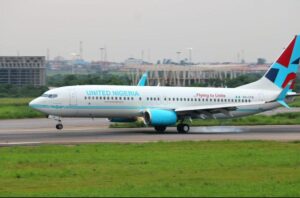

The milestone debt issuance marks a significant step forward in capital market financing for local airlines, providing a robust framework to support the operator’s ambitious growth trajectory.
According to the airline’s September 2026 investor presentation, which details its financial health and five-year strategic expansion, the airline will issue the commercial paper in Series 1 and Series 2, with tenors of 270 days and 364 days, respectively.
This transaction marks the carrier’s maiden offer under its newly established ₦100 billion Commercial Paper Programme.
Meristem Capital Limited is spearheading the landmark transaction as Lead Arranger, alongside a syndicate of dealers comprising Cordros Advisory Services Limited, Coronation Merchant Bank Limited, FCMB Capital Markets Limited, FSL Advisory Limited, and Quantum Zenith Capital & Investments Limited.
The company will deploy capital raised from the offer to optimise its balance sheet, strengthen working capital, and accelerate planned expansion across domestic, regional, and international routes.
Reinforcing investor confidence, United Nigeria Airlines recently secured investment-grade credit ratings from two prominent agencies. Agusto & Co. assigned the carrier a short-term rating of A3 and a long-term rating of BBB- with a Stable outlook.
Similarly, DataPro rated the airline A1 (short-term) and BBB (long-term), reflecting sound financial management and creditworthiness.
The planned market capital raise follows impressive top-line and bottom-line growth. Between FY2021 and FY2025, United Nigeria Airlines expanded its annual revenue nearly ninefold from ₦10.3 billion to ₦90.8 billion. Over the same period, Profit After Tax (PAT) surged from ₦1.3 billion to ₦23.8 billion.
This strong financial trajectory has extended into 2026. In the first half of the year (H1 2026), the airline posted revenue of ₦95.6 billion. Performance remained resilient through the third quarter, with monthly turnover rising to ₦19.4 billion in August from ₦14.1 billion in July, driving a return to net profitability with ₦1.2 billion for the month. Management expressed strong optimism that operations through the remainder of the year and into 2027 will sustain this upward momentum.
Operationally, the airline currently manages a mixed fleet of 10 aircraft, including the Embraer ERJ-145, Boeing 737-800, Embraer E190, and Bombardier CRJ900. To support growing passenger demand and network expansion, the airline expects to deliver six additional aircraft before the end of the year.
United Nigeria Airlines currently services 14 destinations across Nigeria and Ghana. Having secured official approval to operate as a designated flag carrier to six international destinations, the airline is laying the infrastructure for seamless cross-border distribution.
It recently finalised Global Distribution System (GDS) agreements with Amadeus and Sabre, enabling travel agencies globally to access and book its flight inventory directly.
Safety and global operational standards remain central to the carrier’s growth strategy.
An IATA Operational Safety Audit (IOSA)- certified operator since 2022 and a full IATA member, the airline strengthened its international footprint in 2026 by joining the African Airlines Association (AFRAA) and signing the IATA Multilateral Interline Traffic Agreement (MITA), paving the way for deeper interline partnerships and regional connectivity.
Google+